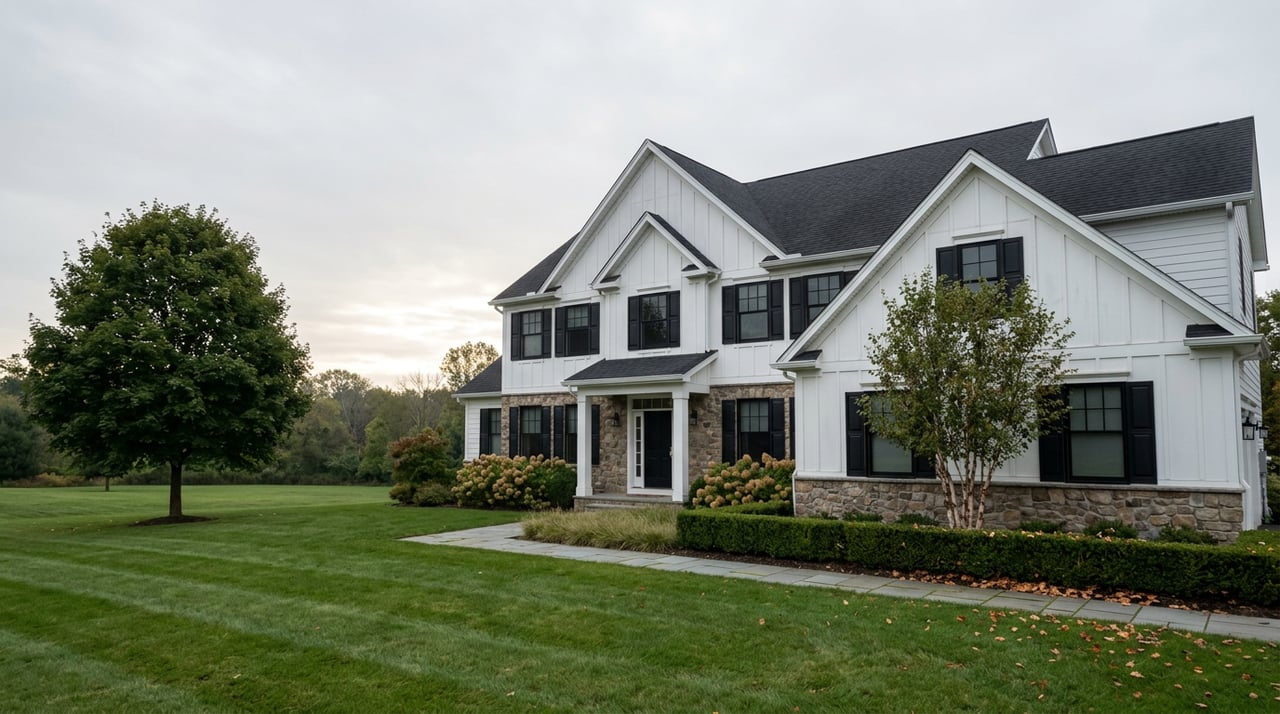
A buyer touring Saucon Overlook this fall will drive one looped road, pass the same stone entrance sign, and stand on lots that all look like variations on the same theme: two to five acres, mature tree lines, long views toward the Lehigh Valley. What that buyer may not realize until the paperwork is in front of them is that the lot on one side of the road sits in Lower Saucon Township and falls under Saucon Valley School District, while a lot a few hundred feet away sits in Upper Saucon Township and falls under Southern Lehigh School District. Same developer. Same marketing. Same road. Two different townships, two different school systems, and depending on which lot you pick, two different resale conversations five or ten years from now.
That split is not a fluke of this one project. It is the clearest illustration I have found of why new construction is so rare in Saucon Valley in the first place, and why the handful of new-build options that do exist here do not behave like new construction anywhere else in the Lehigh Valley.
A 50-Acre Community Built on a Boundary Line
Saucon Overlook is a 16-homesite subdivision spread across more than 50 acres. Ten of those lots sit within Lower Saucon Township, in the Saucon Valley School District. The remaining six sit within Upper Saucon Township, in the Southern Lehigh School District. Every lot is between two and five acres, comes with public water, and relies on an approved on-site septic system rather than municipal sewer. As of this fall, roughly half of the sixteen lots had already sold, with buyers bringing their own builders to design custom homes on the remaining sites.
If you only glanced at the listing photos, you would assume this is one neighborhood with one identity. It is actually two municipalities sharing a marketing name. For a buyer comparing school districts as part of a purchase decision, that distinction matters more here than it would in almost any other new development in the region, because the boundary runs through the middle of the community rather than around it.
Why the Lots Have to Be This Big
The reason every lot at Saucon Overlook measures in acres rather than in the quarter-acre increments you would find in a typical suburban subdivision comes down to one unglamorous fact: there is no municipal sewer line running to these parcels. Water is public. Wastewater is not. Each home depends on its own approved on-site septic system, and septic systems need room, both for the drain field itself and for a backup location in case the first system ever fails.
That is a physical constraint, not a preference. A builder cannot simply request smaller lots and more density here the way they could in a sewer-served part of Bethlehem or Allentown. The land itself sets the ceiling. Saucon Overlook was actually built at the smaller end of what septic will allow. Nearby, a subdivision called Saddle Creek is developing under the same logic elsewhere in Lower Saucon Township, and estate-scale parcels advertised throughout the township consistently run from two acres up into the double digits for the same reason.
This is the part that changes how a comparison shopper should think about "new construction in Saucon Valley." In a sewer-served suburb, new construction usually means more homes per acre and, over time, more inventory relieving price pressure. Here, septic keeps the math capped no matter how much demand shows up. A builder who wants to add sixteen homes needs something closer to fifty acres to do it responsibly. That is a structural limit on supply that persists regardless of interest rates, migration patterns, or anything else that normally drives a housing cycle.
What the Two Sides Actually Look Like
| Lower Saucon Township side | Upper Saucon Township side | |
|---|---|---|
| Number of lots | 10 | 6 |
| School district | Saucon Valley | Southern Lehigh |
| Lot size range | 2 to 5 acres | 2 to 5 acres |
| Water | Public | Public |
| Wastewater | On-site septic | On-site septic |
| Access | Minutes from I-78 and Route 412 | Minutes from I-78 and Route 412 |
Both sides sit close enough to Saucon Valley Country Club and its three courses that the marketing treats the whole property as one lifestyle pitch. For everyday purposes, a resident on either side is living the same Saucon Valley life: same rolling farmland views, same commute into Bethlehem or the broader Lehigh Valley, same rural-adjacent feel. But if you are the kind of buyer weighing school district as part of long-term value, the line running through this development is not a footnote. It is the whole reason to ask which specific lot number you are being shown, not just which community.
What the Scarcity Does to Price
Because so little new construction exists in Saucon Valley, and because what does exist is capped by septic geometry rather than demand, price here tracks acreage more than it tracks square footage. Recent sales in the broader Lower Saucon area have ranged from a roughly 2,000-square-foot farmhouse on a half acre priced near $300,000, up through a 3,000-square-foot cottage near Hellertown around $500,000, to a modest two-bedroom bungalow on nine acres priced closer to $650,000. Look at that spread closely and the pattern is not about finish level or bedroom count. It is about land.
That is the opposite of how pricing usually works in a denser, sewer-served market, where an extra bedroom or a finished basement moves the number more than the lot does. In Saucon Valley, the acreage itself is the scarce resource, because acreage is what unlocks the right to build at all.
What This Means If You're Comparing New Construction Here
If a new-construction listing in Saucon Valley catches your attention, a few questions will tell you more than the finish schedule will:
- Which township and school district does this specific lot fall in, not just the development as a whole
- Has a septic design or percolation test already been approved for this lot, or is that still pending
- What is the minimum lot size the septic system actually requires here, since it will likely be larger than the development's smallest advertised parcel
- How many lots remain unsold in this community, since that tells you how much runway is left before the next round of new construction in this pocket of the valley becomes available at all
None of these questions have a wrong answer. They simply determine whether the home you are picturing sits where you think it sits, on a system that can support it, at a price that reflects what the land itself allows rather than what a builder's brochure implies.
A Few Questions Buyers Ask Me About This
Why doesn't the township just extend sewer lines to allow smaller lots? Extending municipal sewer into a rural, low-density area is a significant capital project, and Lower Saucon Township's water and sewer authorities have historically prioritized keeping rates stable for existing customers rather than expanding service into new territory. Until that changes, septic will keep setting the lot-size floor for new subdivisions here.
Is Saucon Overlook the only place this school-district split shows up? It is the clearest current example because the boundary runs through one marketed community, but buyers looking at raw land or small subdivisions anywhere near the Lower Saucon and Upper Saucon township line should confirm which side of that boundary a specific parcel sits on before assuming a school district.
Does buying an existing home avoid this issue? Mostly yes. An existing home's township and school district are already fixed and disclosed. The ambiguity here is specific to raw lots and new construction, where the same brochure can describe parcels that are, on paper, in two different places.
If you are trying to figure out what a specific lot, or a specific existing home, actually offers once you account for septic, township lines, and school district boundaries, I would rather walk it with you before you fall for the brochure. Let's Connect and get you a clear read on what you are actually buying.